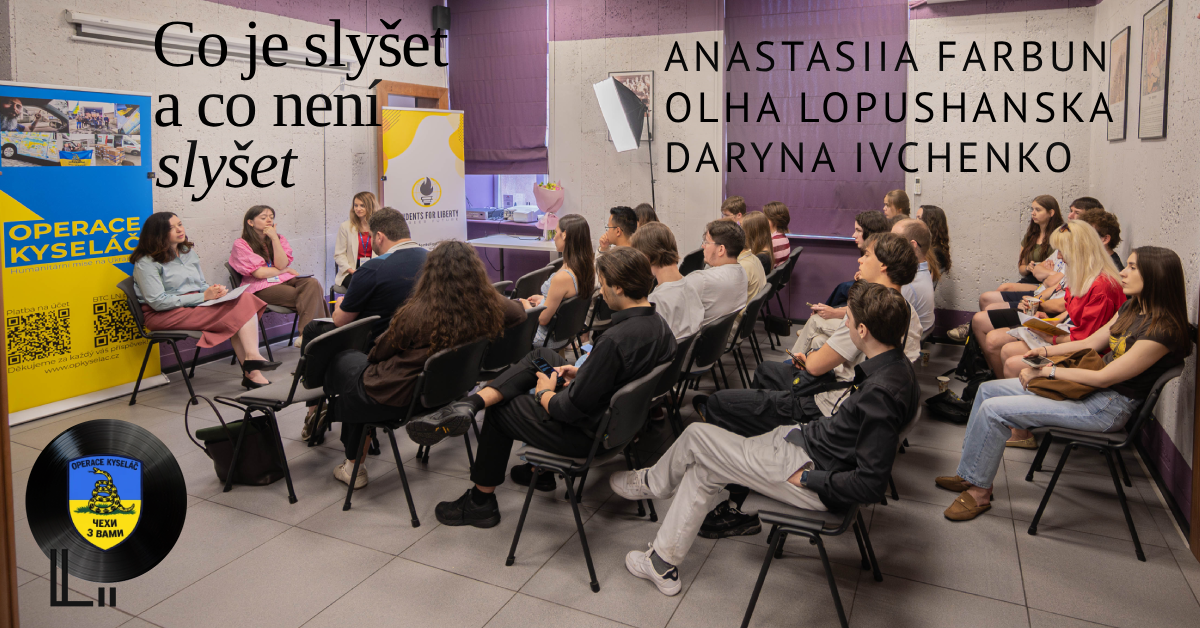
At the 2026 Ukrainian Renaissance conference in Kyiv, we put together a panel on mental health, PTSD, supporting people in a war-torn country, and related issues. After more than four years of full-scale war, the panelists discuss how mental health needs have changed, from the daily toll of air raid alarms to violence against women and children. They also cover Barnahus child-friendly centers, resistance to sexual education, funding cuts and the shortage of psychologists outside the big cities, and why Ukrainian organizations should be treated as equal partners. In the Q&A, they answer a question about living with PTSD.
It features two of the three Ukrainian mental health organizations that our humanitarian mission, Operation Kyseláč, supported in 2022:
- Olha Lopushanska, Associate Programs Director at HealthRight International
- Daryna Ivchenko, Deputy Director for Programs at Divchata
The panel was moderated by Anastasiia Farbun, a Kyiv-based psychologist and art-therapist.
Support our humanitarian mission in Kherson https://savekherson.org/
Our thanks to Nesehnutí for their recommending Divchata and HealthRight when we were looking for partners in mental health and for helping us put this panel together.
Transcript
Martin Pánek
Welcome to „That Which Is Heard and That Which Is Not Heard,“ the podcast by the Institute for Liberal Studies. My name is Martin Panek, and this special episode was taken at our Ukrainian Renaissance conference in Kyiv in July of 2026. We also have a humanitarian mission to Ukraine, which is called Operacija Kyseláč, or Operation Kyseláč. Our humanitarian organization sponsored 3 mental health organizations in Ukraine in 2022. These were Divchata, HealthRight, and Slovyanske Sertse. Two of those are in Kyiv, so we invited them to participate in the conference that we are co-organizing. For Divchata, we have the Deputy Director for Programs, Daryna Ivchenko. For HealthRight, we have the Associate Program Director, Olha Lopushanska. And the panel is moderated by Anastasia Farbun, a Kyiv local who is a practical psychologist and an art therapist. The discussion was about the challenges that the mental health organizations face, what they do, what their mission and strategy is, how the world politics influences their work, about the EU integration, how they help small organizations, how they help people with PTSD, and so on and so forth. I think it was a very good panel, and our humanitarian organization is very proud that we organized that. In the show notes, I’ll give you a link, and if you like what we did and what we’re doing, of course we’ll be happy for your financial contributions. Thank you, and enjoy the panel.
Martin Pánek
Welcome to the second panel today. I will only speak very briefly. We have a humanitarian mission to Ukraine. Our think tank, that is called Operace Kyseláč. If you’d like to learn more about it, go to opkyselac.cz. It’s in English as well. It used to be in Ukrainian, but we were too lazy to update the Ukrainian version, so now it’s only in Czech and English. We’ve been active since the third day of the invasion, and at one point in the spring of 2022, we got so much money—that was before we started going into Ukraine—that we didn’t know how to spend it. It seemed impossible for us to spend it on our efforts, so we asked another NGO called Nesehnutí if they have somebody in Ukraine that we could send the money to, and they recommended multiple organizations, and two of them are Divchata and HealthRight. Divchata means Girls, and HealthRight means HealthRight. And so I emailed them if they would like to join us at this conference this year in Kyiv, and they agreed. So we have Daryna and Olha, and my friend Nastya will agree to moderate the panel, so I will give the floor to her and it’s up to you.
Anastasia Farbun
Thank you, Martin. Thank you. My name is Anastasia Farbun. I’m a practical psychologist and art therapist, and I’ve been around libertarian movements since 2016. And today I’m very happy to be here to talk about topics that are matter to me: mental health, psychological support during the war, and the role of civil society in helping people to go through difficult times. We’re going to discuss two main topics today. First one is protection and recovery: how we respond to gender-based violence, psychological and mental health during the war, and how we can support people who are affected by war the most. And the second topic we’re going to talk about is civil society and localization: the role of how women—sorry—how Ukrainian organizations not only provide humanitarian help but also help to shape it, and what our international partners can do better to work with Ukrainian organizations more effectively. So I would like to give a word to Olha. Please tell us more about yourself and your organization.
Olha Lopushanska
Hello, young people. I’m happy to be together with you today on this great and sunny morning. So my name is Olha. I’m Associate Programs Director in Ukrainian Foundation for Public Health and in Representative. And also we have an office, Ukrainian Office of Health Right Ukraine. Health Right is an international organization with base in the USA, yes, and worked during more than 30 years over all countries in the world. Health Right International had different projects in different countries during these 30 years. After, in 18 years ago, Health Right International has established the Ukrainian Foundation for Public Health there in Ukraine as a local organization, yes, so we were deeply involved in this process of localization, which after we’ll have time to talk more. So our main focus is psychosocial support. Also, after the full-scale invasion, we also evolved to humanitarian assistance, and now most of our projects are evolved to this, to humanitarian assistance. Also, we understand that we have to build our society, make services better—also social services, psychological services—build services for children. So for us, it’s very close—also child protection. And yesterday we have established 17th Barnahus Center in Ukraine. It’s very, very about development because it’s a child-friendly space where there are prosecutors and investigators who provide interviews for children who are victims or witnesses of violence. So it’s our main focus, and we are happy to share some information about our project with you today. And I just want to highlight that the main project became like services in our state. For example, now we work on Barnahus Centers, and we have a draft of law about these centers, yes. And a few years ago, when we started piloting halfway houses—like space where moms with small children could get comprehensive services when they haven’t accommodation, and then they are in some difficult situation in their life. So after this service became like an example of a decree of the Ministry of Social Policy, like start, and now we have decrees about space for women who are victims of violence in Ukraine. So for us, it’s very important to work in humanitarian assistance, but build a very strong system for development and for having these good services in our society. Thanks.
Anastasia Farbun
Thank you, Olha, for giving us a glimpse into your work. And Daryna, can you please tell us more about your organization and what you do?
Daryna Ivchenko
Yeah, sure. Hi everyone. My name is Daryna Ivchenko. First of all, I’m very happy to be here, and happy that our audience is almost full. Thank you very much for allocating your time to this discussion. I hope it will be helpful. My name is Daryna. I work in the Ukrainian NGO Girls as head of programs. Our NGO is a national Ukrainian women-led and women-rights organization. We were founded 7 years ago. Just a couple of days ago, it was our birthday. We celebrated our 7th anniversary. So we were founded with a mission to promote sexual education. And basically, the idea of NGO Girls was created when our director was pregnant and was giving birth to her child. And in the hospital, she was surprised to see while there are so many teenagers, girls, pregnant, the majority for them is the unwanted pregnancy. So she got inspired, and during her leave, she started this initiative with menstrual hygiene sessions for women and girls. And then, like in 2019, it was registered officially. We started with a mission to promote sexual education. So we were entering schools to talk about menstrual hygiene, about culture of consent, first sex, different types of contraception. These are topics which were, and even now, very stigmatized. And for many schoolchildren, it was the first opportunity to hear about this. So it was our primary goal. Then in 2022, when the full-scale invasion started, we shifted our focus to providing humanitarian assistance because the need was there, and we were focusing mostly on women and girls who are evacuating and those who are survivors of violence. Back then, it was very chaotic, very non-organized. We have a team of 10 people, but we had the motivation to help the people and be there for them. Now, as we reflect, we have a team of more than 500 people. 99% of them are women and girls. We are a very family-led team. We call it the Barbie team inside of us. So what we do right now: we grew very big, and on our way, we’re also organizing our work. Right now, we are centered on three pillars, which are interconnected to the issue of violence, gender-based violence in Ukraine. So these three pillars are prevention, response, and mitigation. Sorry. With the prevention, it’s basically our primary focus. It stayed as it is. So we still work on the endorsement of sexual education in Ukrainian schools. We work closely with schools, with teachers, with parents, with the Ministry of Education. And there is progress in this regard. There is a big interest, but the—well, not the family, it’s the press, in fact, to be honest. As we got closer to the official endorsement, we signed a memo with the Ministry of Education. A big green one traditional values company started against us, which is a big pushback we’re trying to overcome right now. A second pillar is response, and it’s the biggest portion of our current programming. So we work with survivors of violence, who are mostly women and girls, who are survivors of sexual, physical, financial, economic violence. So we provide a full circle of support to them, starting from MHPSS, so psychological services, then legal support, cash assistance, dignity kits provision. And then the third pillar, we work with mitigation, because in the long run, it’s not just enough to work with the survivors. Yeah, we respond, but to kind of mitigate the risks of violence happening, we should work in male-dominated fields with men, with boys, but also women, to work with behavioral changes and with biases existing. So that’s the third pillar. But also, we work with children because it’s impossible to fully support women and girls without taking care of their children. We have a big component in our work, which is psychological support, and many, many other things which I won’t mention, but in a nutshell, that’s about us.
Anastasia Farbun
Thank you, Daryna. My next question is going to be for Olha. After 4 years, more than 4 years of full-scale war, how do you think mental health and protection needs have changed? And according to your experience, what were the biggest challenges you faced during this time?
Olha Lopushanska
Very good question. Many thanks, Anastasia. Now, when the war, or the full-scale invasion, started, we see that there are more people who need support, unfortunately. And we understand that even we hope that the war will finish very soon, yes, but we understand that after that, in some time, we’ll get more information about survivors of Russian soldiers, yes, about also sexual abuse, etc., etc. And also, when our military is back, we have an increase of violence, unfortunately. And also, during all our days, even students who are guests in Kyiv, you could have the opportunity to understand our reality: that when you have all day, every day, air alarms a special few times, your mental health is not okay. Our mental health is not okay in different ways. Even we could understand from people, from our families, from people with whom we work every day, we understand that people, that it’s very difficult to have that normal life and normal task, even at work, that we had before. So also, we understand when that economical situation in our country is not okay, especially that territories which are occupied, and when people go away, then become refugees, or as in Ukraine, we call them inter-IDPs, displaced people. They left all that they have, yes. They just try to take their children, their families, their parents, their animals. And it also, in many cases, could be a problem how to go with them and what opportunity they will have when they come to another city in Ukraine or even abroad. So unfortunately, even that people who live in their normal life, not in difficult circumstances, as we call this in our work, yes, like humanitarian workers, like in people who work in social sphere, psychosocial sphere, yes, their conditions of their life became not so okay that they have previously. And unfortunately, they try to find where is the exit, yes. They try to find a job. They try to integrate in new communities. But then they come, they can understand that they never will have their previous life. And that people, that very, very often in new communities, they try to help them. And most of us understand that. But after their situation, that people could go at occupied territories. Now, in Kyiv, we have two halyfway houses, something like social apartments for boys and girls who returned from occupied territories. Most of them have not only psychological, psychiatric problems. They get pills to have good dreams, something like very close, not often, but something close to normal life, and they couldn’t. So it’s very deep, that problems that they have. It’s very deep problems. And even in Kyiv, or in most safely space in Lviv, or in Western Ukraine, even from Kyiv, they also have air alarms. And one of our social workers in Lviv, she also was affected. So in some understanding, we could think that Lviv or Western Ukraine is safer. Okay, it’s safer, but it’s not safe in all understanding of this world. So unfortunately, also under statistical information, statistical data, violence after full-scale invasion increase, percent of violence, percent of children who are affected by war. And it’s not only physical affected and not only psychological affected. It’s also about economical conditions that their parents have. And very often, when we have communication with the Office of General Prosecutors, they’re afraid in new cases about affected children because they’re very terrible. So unfortunately, we have not okay situation, and we understand this, and we understand that we, like humanitarian workers, humanitarian organizations, could be more involved to help in this situation.
Anastasia Farbun
Thank you, Olha.
Olha Lopushanska
Thank you.
Anastasia Farbun
Daryna, your organization works closely with survivors of gender-based violence. Can you please tell us which trends have you noticed over the past few years? And maybe tell us about your success stories or not such successful stories which became valuable lessons?
Daryna Ivchenko
Thank you. Yeah, to be honest, the things that Olha mentioned are already it’s a very good observation on the situation which is right now on the ground. So the hard truth is that, in fact, we will never have accurate data about gender-based violence because it’s always underreported, always. And when in 2022, there were decreases in the number of people reaching out for support, we guess that it’s not because, in fact, there were no violence happening. Because women, girls, people who survived, it wasn’t a priority for them. The priority was the survival of a country, war, which started not the violence happening in the family. So it’s a big question how we even interpret the data and statistics that we have. But what we have right now is that according to National Social Services, there is observed decrease in the number of domestic violence happening, but decrease in the number of violence happening to children. So when in 2021, out of all reports, 2% were done by children. Now it’s 6%. It seems like a moderately low figure, but again, it’s children, the mostly unprotected and vulnerable population. And again, it leads us to the matter of importance of sexual education, what we do and what we advocate and what we try to promote. Because what we teach them when we enter the school with a sexual education class, that’s about the safety. It’s about how to report and how to reach out support if something happens. And it’s very upsetting for us that this, again, campaign which started against the backlash happening and the selling all the traditional values. Because for them, it seems like what we do is LGBTQI+ propaganda. It’s abuse of children. And it’s not like that. And we do our best to make a coalition of supporters to tell that it’s also the part of our EU integration. It’s part of democratic values. And if we look at those countries, like Nordic countries that have endorsed sexual education in schools, the level of violence there is way lower than compared to those post-Soviet Union countries because that’s what matters. Another trend that we’re observing is that the number of women returning to the abuser after they left him is higher. So we work with cases when, for example, someone reached out to us through our psychological hotline or just wrote to us via social media. And we start work. We open this as a case management. So we work individually, and we call it this case management. Then we provide the full circle of support. We provide cash assistance which can be used for accommodation or for rent. But then there are cases when women again got back with the abuser because very often, it’s the reason and the matter of financial dependency and the lack of financial independency from the survivors. That’s why how we work with that, we also combine. We not just respond, but to those who are in a more stable setting. We teach Ukrainian population, but again, mostly women and girls, about legal safety. What are your rights when you enter the labor market? How to defend them, how to be proactive, how to be assertive, how to be more financially dependent, saving debts, and etc. Then what else? A couple of years ago, we had our assessment on GBV, again, like GBV trends after the full-scale invasion. Part of this data is still relevant nowadays. And we found out that only 18% of all women and girls know that financial and economic type of violence, it’s also violence. Because mostly, when we think about this word, we have associations in relation to sexual violence or physical because they are more harsh. But financial, economical is also part of a problem. So there should be more comprehensive support. What else? Time also is very important when we respond. Even though we’re a national organization, we’re quite flexible. We operate using the funding from institutional donors, and we operate guided by their rules. And we are flexible compared to many international donors or to many international organizations working in Ukraine. Still, when violence happens, time matters the most. So a couple of days ago, we launched our emergency fund where we will provide emergent cash assistance within 24 hours. We started the fund with our own contribution, which is 100,000 hryvnias. It’s a bit more than $2,000. And we plan to fundraise with it. We plan to fundraise with flexible funds so that when women, girls, men reach out to us, we can quickly respond and make sure that the medicine, rent, I don’t know, transportation, it all can be covered quickly, and they are able to break the circle of violence and flee from the abuser. The last point I wanted to make, which may not be that evident. I mean, in our humanitarian bubble, we talk a lot about it, but as we have this good combination of people coming from different sectors, students, I wanted to raise the issue of conflict-related sexual violence because it’s a weapon of war that Russians use. And thanks God, right now, we have a bigger number of people who have been returned from the captivity, but 95% out of all are survivors of conflict-related sexual violence. And it’s good that we talk a lot about reparations to them, but reparations haven’t started yet fully. It was just a pilot. There should be more. And those projects are very costly. So our NGO also works with those survivors. Those are mostly men because men are mostly in the captivity. And there should be more work and advocacy also for the funds for those specific category of people. Yeah.
Anastasia Farbun
Thank you, Daryna.
Olha Lopushanska
Just to see, I just want to add about the second question about challenges. For us, it’s very important to make services closer to people, especially for affected people who reach close to conflict line, yes. But that’s challenges that we see now. And maybe, Daria, I think that maybe in your organization, you have the same. It’s lack of professionals, lack of psychologists in different regions. And very often, I have meetings and communications with colleagues from different regions, from our team, especially from social services. Last week, I visited Chernihiv. It’s very close to Kyiv. And the same that we have share from different regions and that we have because also our teams work in different regions and even very close to front line. The first challenge is lack of staff, lack of professionals, especially in regions. So my message would be that we need you, all of you in Ukraine, like professionals, to develop our society, to build better services, and to build better life in Ukraine. It’s first point. Another point, it’s lack of funds. And very soon, we see this now, and very soon, this talent would be bigger. And we know about this because many humanitarian organizations, they built this humanitarian response. And now, all we hope that very soon, maybe in some way, it would be another situation. We hope that war finish, but maybe it would be some prism, something like that. So the next step in this humanitarian response could be nexus or early recovery, etc. And at this stage, that funds that we have, like humanitarian actors, all NGOs in Ukraine, humanitarian NGOs, we will have less money. So for us, like NGO, non-governmental organization, and for other players on this market, it’s also another issue or another opportunity to build consortiums, yes, to build partnership. So maybe for you, like for students leaders, it also could be interesting to if you want, if you see yourself in humanitarian or maybe not humanitarian, in non-governmental organization in future. So it’s good opportunity that you have it either today and these days at this event to build partnership. So trust me, very contacts that I have from my student’s life, it was many years ago, they work. So it’s another my message for you. Build partnership just now, yes, from this time with each other. And another option is lack of services. If you plan build services for people not in big cities, not in capital, build it in small towns, in small village, it’s a great idea. So build it. And that people who leave children, women, men, not matter, elderly people, they will say, „Thank you.“
Anastasia Farbun
Thank you. Now we have a little bit time left for our last question. Just please tell us briefly, a few words about roles of your organizations in localization.
Daryna Ivchenko
Yeah. I can start. I would like to start maybe with definition, how do we understand localization in our setting? So Ukraine has a very vibrant civil society. That’s one of the things that also makes us different from Russia. In Russia, there is no civil society, no democracy since then, etc. We have it. And the majority of the civil society founders are women. That’s why our role as NGO girls is also to capacitate women rights organizations who work with the protection of women rights, with empowerment, with gender questions. And because we have the vibrant society, when the invasion started and many donors, many international, non-governmental organizations entered the country, we started operating together. And there were no equal opportunities to us because we are those who know the context best. We are those who should have the same access to the funding as well as international agencies. But for some reason, we did not. And the percentage of funding going directly to Ukrainian organizations was very low. And localization is basically this fight, advocacy towards more equal opportunities to Ukrainian civil society sector. And our priority here is especially focusing on women rights organizations, which is especially relevant after all the things that was done by Trump’s administration, including Mexico City policy, which prohibits for those organizations working on diversity, equity, and inclusion issues to receive any American funding. And if they receive it, they will be restricted to receive any type of funding, not just American, but any. We don’t know how it will be worked in practice, but that’s very frightening, to be honest. And what we do in terms of localization, so we advocate and we organization who basically grew from local international within three years. And we try to be the voice of many grassroots and local initiatives, but also not to be the voice. We just work with them. In our projects, we form consortiums where we invite them as a co-implementers, as a joint partners. And that’s also our message to international society. Treat us as equal partners. At the same time, I do understand that trust, it’s not something that can be easily given. Trust can be earned. So it’s also our responsibility as a civil society actors to be transparent, to do auditing, to do reporting, because that’s also the measure on how we build this trust and how we can prove that we really deserve for some reason, we still have to prove it, that we deserve to be equal and to have voice when decisions are being made on how the assistance, the humanitarian funding should be yeah, spread, disseminated. Thank you. A case from our work. So recently, we started providing subgrants to small organizations. This starts with a needs assessment. So we may procure some, I don’t know, ecoflows or strategic session to them where they strategize and just have space to think, what is the mission, what are our strategic goals? Because if it’s the organization which is working the Hromada level, they very often do not have time, neither resources to think on this. They are fully committed to the work to the people. And then we give them the space to facilitate the discussion so they grow operationally. And then we provide grants for their work, how to integrate gender equality principles to the Hromada response or recovery planning. And maybe the last point, because I also wanted us to have a Q&A session, is that women rights organizations is very much underused resource for EU integration because we do and know a lot of things on the ground. And we can help to do this recovery and integration from the bottom to the up, which right now is happening the other way around, at least from what we see. So yeah, and it’s a good opportunity that we were here today. I mean, it matters. It means that it matters that we are visible. So thank you for the invitation. And I’m sure that you all are also here for the democratic values and just a point that women are also a big part of the recovery and of the integration. So keep this in mind, and we work on this together.
Anastasia Farbun
Okay. Martin. I’m guessing our timing is enough to let Olha speak about localization a lot, or should we move to questions?
Martin Pánek
Like 10 minutes.
Anastasia Farbun
Okay. So yeah, Olha, please.
Olha Lopushanska
Okay. Thanks. Just a couple of words from our side about localization. You understand the idea, yes, that there are big international organizations who came to Ukraine. Many of them came to Ukraine when the full-scale invasion started, yes. And they also bring with themselves big funds. And in some time, it also could be big opportunities also to strengthen that local organization that operated before in Ukraine. So the main idea of localization, not only because in some time, we hope the war will finish. So it’s not a question. But when it happened, this big organization, they lose the interest to continue work. Maybe in some way, it could be development to develop some services, especially military, social, child protection, etc., medical, because healthcare is also very important for us. And it also needs funds to develop, to make this technology, etc., etc. But what would be after when these funds finish and we have or not have some change in our society in many, many spheres? So the idea of localization to help small or big Ukrainian local organization to be powerful and to have this capacity to continue provide support, provide services, provide expertise for people, for population in Ukraine, to make their work good. And many of international organizations, when they come, they provide their SOPs, standard operational procedures. They bring some of their ideas what could we do to make these services better, to make our law better, etc., etc. So the main idea to put more power, expertise. It also could be funds to develop staff of local NGO because it’s also very important because some projects end, and we have to think what will we do with that great, for example, psychologist, with that great manager, what could we do because we haven’t now free vacations in another project. So that’s challenges that we like NGOs have every day. So the main idea to provide funds to have this work on sustainability work, yes, to have staff, to have expertise, to bring expertise from another countries. And foreign expertise, it’s not very good in our Ukrainian reality. So we have to adopt this expertise, yes. So the main idea in localization to build strong NGOs. And I just also want to highlight that in many cases, Ukrainian non-governmental organization are very flexible to make reforms. For example, our Barnahus center, state couldn’t do this because state haven’t money, funds for this. And state has law which not regulate such instrument, yes. But now, during five years of implemented this initiative, we have 17 centers. And we have more than 3,000 children got services in this safe space. So not investigator, not DAT, provide interviewing for that children who were victims of violence, but psychologist in comfortable conditions and in such conversations like now we have, but not investigator, not in police office. So it’s about reforms. And it’s about that NGO are flexible. And when we have this partnership, because NGO couldn’t be like state, like governments, and we couldn’t do their functions, but we are ready and have possibility, have expertise to help government to make their reforms. It’s very, very short because I understand that we have time.
Anastasia Farbun
Thank you very much, Olha, for sharing.
Olha Lopushanska
Thank you.
Anastasia Farbun
Thank you. So I think we have time for a few questions. Does anybody want to ask anything our speakers?
Speaker from the audience
So a lot of the problems with post-traumatic stress is many people, they complain about lack of structure in their lives after so long of doing something every day, every day, every day, and then absolute freedom. So what would you guys say you would do to help people who are suffering from post-traumatic stress, who want the freedom but need the structure? Is there some plans or good ideas that you have for that?
Daryna Ivchenko
That’s a very good, and I would say also philosophical question, to be honest. I have no answer. I mean, I also was diagnosed with PTSD. And the majority, I think the biggest population of Ukraine has it, and it will be with us for decades, maybe for the rest of our life. Maybe the solution I have personally is I try to keep the structure where I have it. I mean, that’s totally chaotic. We cannot predict when the next challenge will take place or when we have suddenly change our plans and go to the shelter because there is, again, this drone attack or ballistic attack. But having the routine and what we do on the level of our NGO is that we try to bring the hope back and to try to reteach people to find the beauty in very simple things like the smell of a food or the smell of flowers. And it takes lots of time. I mean, that’s also why we advocate for more long-term psychological support because the standard up to five consultations, that does not really help when people have severe issues. And it’s a standard up to 10, but we try to, when we have the flexibility, do it at least 10 consultations for people because on the eighth consultation, it may be the first time when they mention some severe event happening in relation to war. So I mean, I don’t have the answer, but it’s also the responsibility of the government to pay attention to this matter. We civil society work a lot, but we see that there is a discrepancy on what we promise people and what the government can do. So we should do it jointly.
Anastasia Farbun
Thank you very much.
Olha Lopushanska
My advice would be not to stay alone. I understand that there are some foreign students and there are Ukrainian students. So if you understand that something is not okay, there are so many services. So you also could just text to GPT, a few of our beneficiaries of our social apartment or halfway houses, they found us from GPT chat. It was a surprise for us, yes, how technologies work, but you could answer. So there are many, many services, and some from NGOs, some from governmental. And it’s not so big problem to come to psychologist and just to get some advices, some tips, what could you do? And there are so many very, very simple interventions, very simple something like psychoclass.
Daryna Ivchenko
It’s like basically.
Olha Lopushanska
Yes, yes, yes. So not to stay alone if you think that something maybe it’s not okay in your opinion or from your friends, from your families, just find some assistance from NGOs or from governmental, not matter. But not to stay alone with some problems or issues.
Anastasia Farbun
Thank you.
Daryna Ivchenko
Thank you.
Anastasia Farbun
Thank you.

Martin Pánek je ředitelem Institutu liberálních studií. Vystudoval ekonomickou analýzu na NF VŠE. V minulosti působil jako asistent europoslanců v Evropském parlamentu a aktivně se angažuje v Operaci Kyseláč. Zabývá se mezinárodním obchodem, migrací, svobodou slova, lidskými právy nebo americkým ústavním právem.