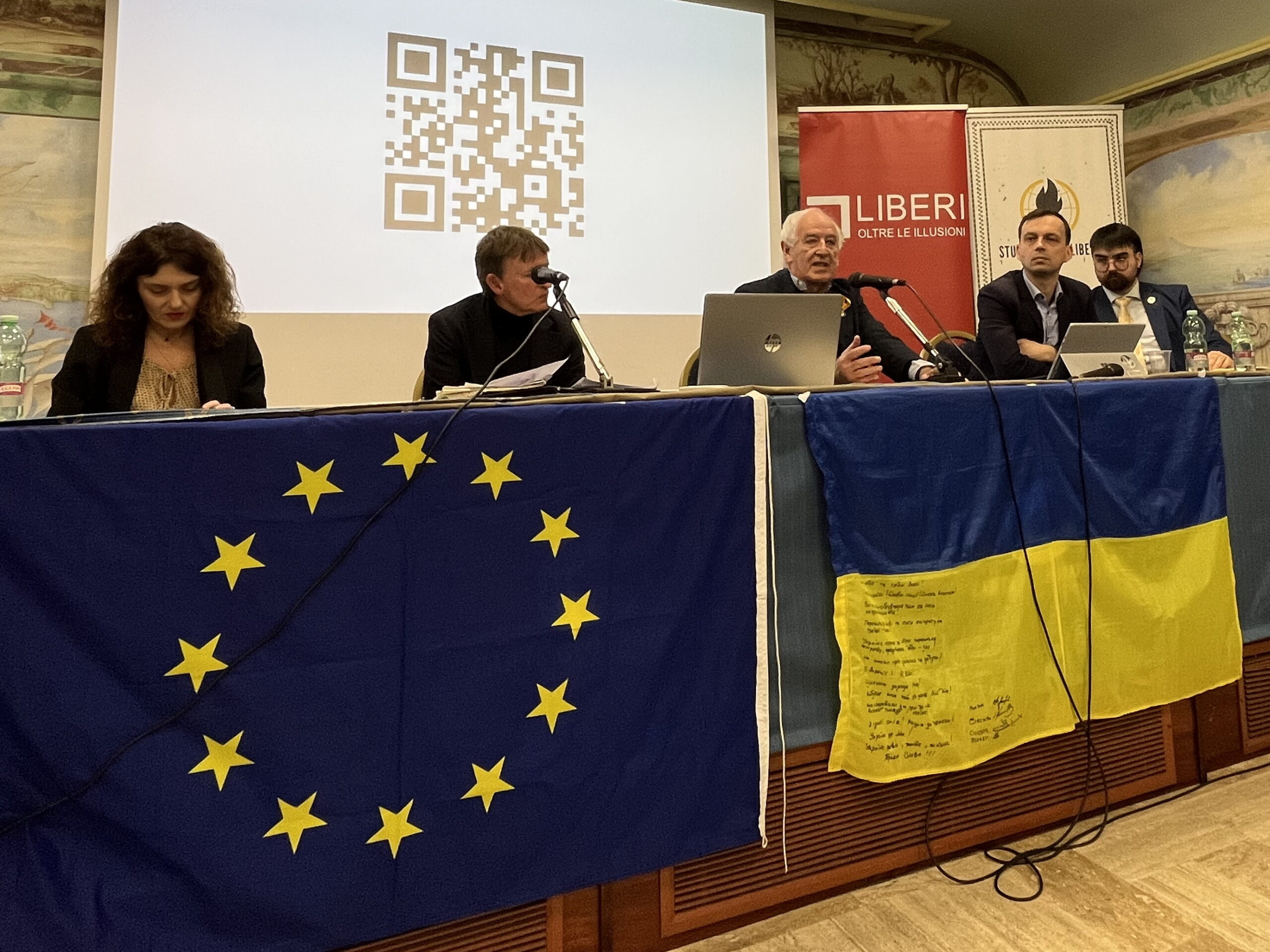
Remarks delivered at the Gloria agli eroi: Quattro anni di guerra conference in Rome, on February 21, 2026.
Buonasera! Unfortunately, my Italian isn’t very good, I might have a better chance speaking Ukrainian, so: Доброго вечора! But I will deliver my remarks in English.
Four years ago, on 24 February 2022, Russia invaded Ukraine, starting the largest and deadliest war in Europe since World War II.
I woke up and kept reading Twitter all day. And then all weekend, because the news from the war kept coming so fast.
To be sure, the invasion itself was not a surprise. In late 2021, Russia massed troops near Ukraine’s borders and issued demands to the West, including a ban on Ukraine ever joining NATO. We all hoped that Putin would eventually not invade but all the talking heads who claimed that there was never going to be a war were catastrophically uninformed or lying.
In the evening, we went to a pro-Ukrainian demonstration in Prague. That was when I first heard the chant “Slava Ukraini, heroyam slava!” and I asked my friend from Ukraine if heroy meant hero. I think Ukrainians have shown us conclusively that they indeed are heroes. Interestingly, there was a Students For Liberty meetup that night in Prague which we went to. It was on inflation which shows how quickly and overnight our main topics changed. By the way, thanks to Students For Liberty Italia and to Mario for inviting me here today. I forgot to say that at the outset.
The next day, on Friday, my friend whose dad is a mayor in a small Ukrainian town began organizing humanitarian help. Me and the future chief of our humanitarian mission met in the evening for beers and after drinking several, we thought maybe we could also go to the border to deliver supplies. We love sour ale, which eventually gave the name to the humanitarian mission: Operation Sour Ale, or Operace Kyseláč in Czech.
On the third day of the full-scale invasion, we departed from Prague, bought some basic food, sleeping bags, and power banks and on the Sunday, the fourth day of the war, delivered it to a Slovak town on the border. We visited the border town of Ubľa to see if there was any help needed. There, we encountered three Ukrainian ladies who seemingly had nowhere to go. We offered to take them to Prague. That’s when we learned that the Ukrainian and Czech languages are not as close as we had hoped because the conversation was very difficult. That’s how our mission started – deliver supplies to the border, deliver refugees from the border.
Thanks to the generous donations of our Facebook friends, we were able to finance these trips in the first few months of the invasion. Then, there were no more refugees at the border, so we had to go into Ukraine directly. By luck, we found that medical professionals were needed in a hospital in Lysets, close to Ivano-Frankivsk. Our chief of mission is a former paramedic and so he went. We quickly established a partnership with this hospital which is the only private hospital in Ukraine taking care of veterans. Before the invasion, it was a plastic surgery. The director of this hospital Stanislav told me that he thought they would take care of veterans for a couple of months. They will soon reach their 50th month.
If you talk to Stanislav, you see how grateful Ukrainians are for any help. You can still see all the cars that we donated working diligently. And it makes me very angry to read comments from people on social media claiming that everything is stolen or that there is no war and Putin only wants peace or some such.
But back to our story. During this work in Ivano-Frankivsk, our mission chief Vít made friends with medical professionals from Kharkiv and Kherson and our mission started supporting those hospitals, too. The one in Kharkiv is an orthopedic institute and the one in Kherson is a maternity ward.
We’ve supplied all of these with ambulances, cars, money, medical aid, and perhaps most crucially with being able to actually go there because, especially in the recent months, the road to Kherson is very treacherous as it is very close to the frontline and the Russians like to send drones to kill ordinary people in the city or on the way to it. I personally wouldn’t have the courage to go there, but our brave drivers Vít and Denisa do have it and are able to still supply the hospital.
Of course we go to other places as well when the situation needs it. We also support a couple of Czech soldiers who enlisted to the Ukrainian army but for security reasons, we cannot give any details at this moment.
All this help is ongoing and we couldn’t do any of it without contributions of our supporters for which we are very thankful.
In the last three years, we co-organized with the European Students For Liberty and with the Ukrainian Students for Freedom a policy conference called Ukrainian Renaissance. First, in Ivano-Frankivsk, and then twice in Lviv with participants from all of Europe and some overseas visitors too (I can recall seeing participants from the US, Brazil, and New Zealand).
I think that it’s important to connect with like-minded people in Ukraine and elsewhere, support local people by organizing a conference like this and show them we still support them, to show non-Ukrainians that it is safe, or more or less safe, to go to the Western part of Ukraine and to remind everybody that we should not forget about Ukraine and we must support it. Seeing the audience here tonight, I don’t need to remind you that this war is ours as much as it is Ukrainians’.
My parents lived in a country occupied by Russia, they hated it. (Technically, I lived in it, too, but I was only two years old when the revolution happened.) They still hate it that their entire youth, they had to live impoverished and unable to travel. For them, a trip to Rome was a dream beyond reach. But they are happy and supportive that I can now come to Rome and urge everybody to resist yet another Russian occupation.
To be honest, I think my generation, and certainly I personally, thought of Russia until fifteen years ago as a normal country or a normal government in the sense that we didn’t think they would start a genocidal war. We were in a for a rude awakening.
This year marks the 250th anniversary of the declaration that, “all men [have] with certain unalienable rights, that among these are life, liberty and the pursuit of happiness”. I conclude with wishing the Ukrainian people the chance to pursue their own happiness, independent of Russia. On a poster by the Ukrainian Students for Freedom at one of our conferences, I saw the claim “Liberty changes the world”. And remember that the full name of the Statue of Liberty is Liberty Enlightening the World.
Let’s hope that Liberty will enlighten and change this world for the better, including a Ukrainain victory. Glory to Ukraine, glory to the heroes!
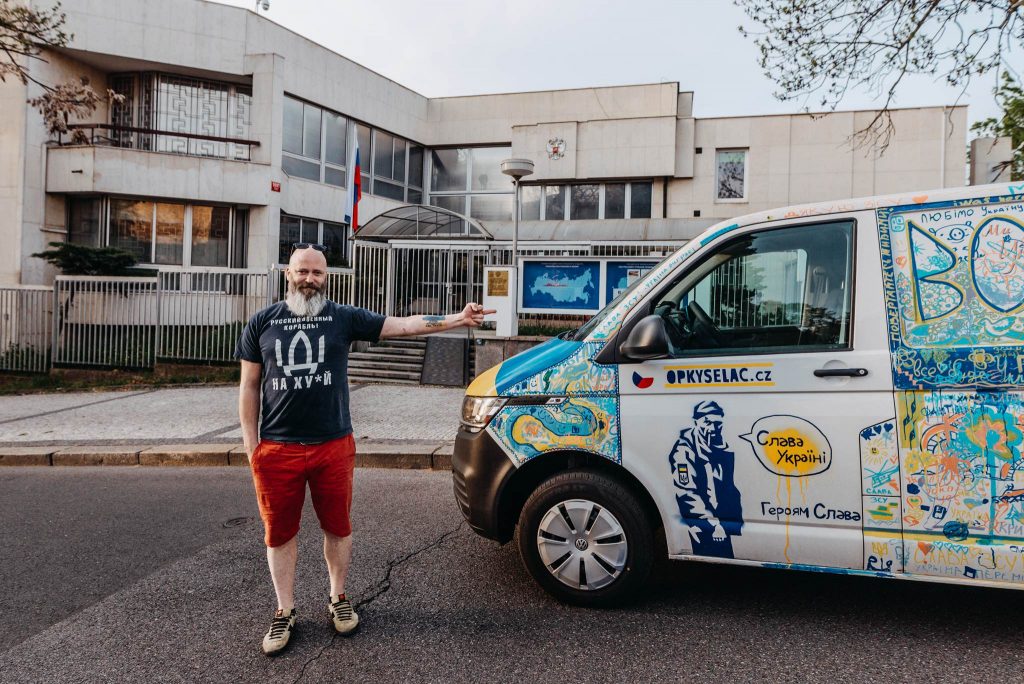

Martin Pánek je ředitelem Institutu liberálních studií. Vystudoval ekonomickou analýzu na NF VŠE. V minulosti působil jako asistent europoslanců v Evropském parlamentu a aktivně se angažuje v Operaci Kyseláč. Zabývá se mezinárodním obchodem, migrací, svobodou slova, lidskými právy nebo americkým ústavním právem.